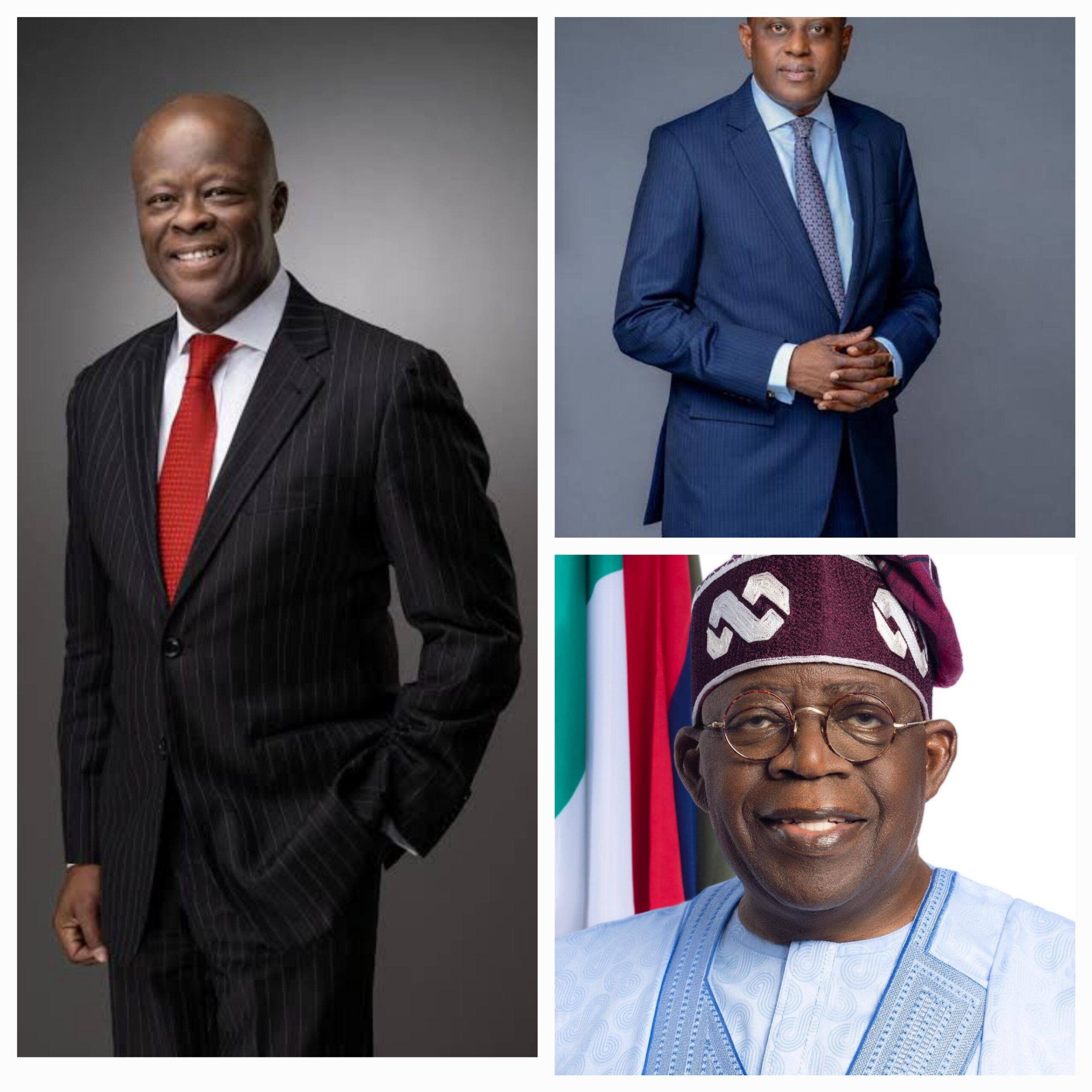
President Bola Tinubu’s First Year in Office which was marked a few weeks ago, sues for a new monetary and fiscal policy framework as the major fulcrum to propel its economic ideals based on its seeming rejection of what was on ground on its arrival. With a new Finance Minister, new Central Bank Governor and new economic team, an entirely new program was already on its mind, ab initio. Writes our Economic Intelligence Unit.
If the Central Bank of Nigeria has been managed by 20 governors since inception over sixty years ago, it also means that the apex financial institution has also operated over twenty strategic policies to manage the nation’s economy. This assumption remains very relevant as each governor had ruled the CBN with his different policies and some have changed their policies over three times before their first terms were over. There may not be anything wrong with policy change, but there are a lot of differences when there are summersaults in policy developments and their consequent implementations.
The beauty of continuity has become a major illusion within the management of the Central Bank of Nigeria (CBN) even when there is the same governor over a spate of five years, as the case has been most of the time. This has not only derailed many policies and development directives, but has cast a very dark pall on doing business based on the flexibility of the major indices on which the economy relies.
For a very long time in the history of Nigeria’s monetary policy, inconsistencies have been the bane of monetary and fiscal policy management and that has been why institutions whose activities critically depend on the various rate regimes find it difficult to be here for good.
It is emphatic that only institutions that can deal on Futures Commodity Market (FCM) can be here for long, galloping in and out, as long as the futures prices make any sense to them. This is typical of any country that battles instability in its rates (forex, lending etc). Since 1985 Nigeria’s rates regime has been flowing in a staccato, not knowing the next rate to behold, and this has given room for a deluge of options and experiments, creating the situation and condition as a country that operates a “Foreign Exchange Economy”.
The implication is that the CBN has given more attention to instruments managed by banks and has given little attention to the issues about the real sector, to the extent that critics at a point tagged it ‘Central Bank of Nigerian Banks’; indicating that the CBN is just out to offer more attention to the banks in the country’s economy. This is because all policies had tended to focus banks, while in the actual sense it is what happens outside the banks that really shape the economy.
From 2015 to date, the story has not changed. What has happened in the country’s monetary and fiscal policy directive is that a lot of caution has been applied with some haphazard measures that are perceived to ensure some palliatives but which are largely imaginary. What ruled the monetary and fiscal policy thrust of 2015 was principally the fact that the forex market went to blazes immediately the new government came into power and this was the first baptism the Central Bank Governor had. In a move to forcefully return the Naira to its N185/$ position, a plethora of rules and regulations were infused into the market with the concomitant consequence of keeping the exchange rate at a level never known to Nigerian money market history. Before the apex bank could offer another bunch of rules, the rate has moved to blazes and has been calling for fire and brimstone to bring it down from N360/$ from where it met the present storm.
Today, a good portion of CBN’s energy and logics have been expended on the forex market, but its current rating seems as if nothing could be done anymore. The more the apex bank infuses more dollars in the system to fight the scourge, the more the money market looks untamed. The events of falling oil price and stagnant unfulfilled quota have been propounded as major reasons for the rates down-turn, but the pictures of very poor productivity within the economy seems more reasonable than the issue of falling oil prices, because the various segments of the Nigerian economy which harbour more growth opportunities than oil and gas seem to have been unattractive to the banks and other investors that are much more at home with oil and gas income.
The current administration is living up to the billings of most previous administrations that summed up Nigeria’s 25 years of new democracy. Its approach to monetary and fiscal policy directions can be seen from the point of the huge pressure it contained with on economic management framework during the very heated debates on what must be done with the economy. Three major monetary and fiscal policy directives that have become the main spanner in the present economic trend are the response to the lingering subsidy debate, the abolition of the Currency Redesign Project and the discontinuation of the dual foreign exchange policy. Much as these were monetary policy trusts of the past administration which were subject to various conflicting responses by various technocrats, they were also seen as the most popular appendages of the administration believed to have been seriously unpopular. The action of the current administration to this was seen as an indication of its new economic direction as well as the belief that it was coming with an “agenda” believed to have undergone more refined approach in a view to distance itself from somewhat unpopular economic policies.
The last electioneering campaigns were to a great extent built on issues when compared with previous ones which were mainly characterisations of various modes of name-calling. Nigerians were made to tinker infrastructure developments, job creation as well as productivity. They also promised eradication of hunger and reduction or extermination of poverty. These are basic needs that can only be achieved using the vagaries of monetary and fiscal policy. This must be why the Tinubu administration was quick to jump into the three major issues they believed that habour the properties to determine adequate economic prosperity, even though they were not sure of the multiplier effect in an economy that carries a great burden for over 200 million people, 83% said to have been living below poverty line with about 60% of the entire population completely unemployed.
With its “Subsidy is gone” declaration, the administration wanted to win the ‘political war’ as well as the ‘economic war’ which were seen as the answers to the scaring predicament of the average Nigerian. Nigerians really wanted an end to subsidy as propounded by their IMF and World Bank progenitors, but became so livid when the cookies that offer much fillip to the economy started to crumble, sending prices of basic products and services to high heavens. The projected positive step by armchair economists later became the Achilles heels of the new fiscal policy guidelines, as transportation rocked, sending foods prices high as fuel price became major determinant of every activity that was undertaken within such a very short time. Suddenly the much cherished campaign swan song by all political parties became a cause; subsidy became a cause and no more the blessing that was configured during the campaign times. But the failure of the declaration found a resting place within the confines of the Tinubu administration which has been blamed for releasing a vulture to the community instead of an eagle.
The claim to operate realistically with the trend of the dwindling revenue could not assuage the disappointment of the electorates who felt that they asked for a falcon and got a falconer. But the truth about the subsidy removal and its predicament is laden with such predicament; a rather very difficult outcome the World Bank did not reveal to Nigerians, has rather becomes Tinubu’s nemesis.
The belief was that, has he prepared the minds of Nigerians and carried the various development institutions along, the reaction could have been negligible. As a matter of fact, both the very strong and very weak institutions were hit by the development and the adjustment to withstand the effect became the forte of all and this caused a counterpoise to the economy, a development that is still a major reason why the economy is still struggling. The National Bureau of Statistics (NBS) has it that in the last twelve months, petroleum prices recorded a 223% rise, inflicting composite measure of cost in all the associated areas it is applied for use in the economy.
As if this maladjustment from the fiscal policy direction was not enough, the CBN released its paraclete through a monetary policy to address the foreign exchange management which was seen to have been poorly structured by the previous administration in its dual exchange rate policy. The Governor ordered a merger of the two guidelines to produce a unified outcome. The market rejected the development as it was again taken unawares like the subsidy removal order. It was like a bolt from the blue. The market trembled and started to quake in a manner that a huge devaluation of the Naira was recorded. Ab initio, the Naira became a victim for the holocaust. From that morning, the Naira embarked on a journey of no return; moving up and down in a roller-coaster, the way no one could plan with it unless you must swim and sink with it as a matter of necessity. Today, the monetary policy measure embarked under this merger guideline has failed to be retrieved to any significant importance even though economists also believe that it is the way to go. Even as much, other economists believe that the issue is not whether it is the way to go or not, the issue is more of the timeliness factor and the communication factor.
Just like subsidy removal as the first fiscal policy release of the presidency, forex merger was the first monetary policy release of the CBN. The two which happened to arrive almost simultaneously remain the major controversy in the economic policy directive in the last one year of the Tinubu administration. The naira still hovers around N1500/dollar as against N400/dollar twelve months ago.
The inflation trend and exchange rates are also some of the major economic indices that respond to outcome of elections and the release of economic policies of new governments across the globe; it is either they move up or down , or remain static as a matter of the situation. In this case, inflation is now 34% while interest rate on lending hovers between 28 and 35%. Our debt stock across has quadrupled while our debt services obligations have taken up to 91% of our revenue. The strength of our annual budget has weakened as its debt servicing component makes the appropriation look more like a mere budget to take care of debtors. With a non-progressive foreign reserve record, our trade obligations have been very poor.
But the fact remains that new monetary and fiscal policy directives are being churned out on monthly basis as new experiments to lift the economy continue to be tinkered. Nobody has been able to offer a clear result of what the policy would come to be but the issue is that trials are effortlessly being reproduced and if all things are equal it may come out good or create an error parallax somewhere. For instance, a good number of policies have been directed towards the banking sub-sector to the extent that the administration has sued for a new banking sector consolidation through which a second phase of recapitalisation must be consummated soon. The government believes that the existing 35 banks are not making enough contribution towards the funding of infrastructure, thereby pushing it to dip its hands into dedicated funds and getting into other borrowings. It has continued accusing banks of making huge profits and sharing the funds among the owners, without minding that these banks are private sector investments under rules of the Companies and Allied Matters Act (CAMA).
Already, the new recapitalisation policy has kicked off and it will only help the funding of the much needed infrastructure decay if the value of Naira improves and if there is also a reduction in the rate of inflation as well as a reasonable drop in the rate of interest.
While various tariff regimes have been adjusted upwards in search of revenue, the various services rendered by government or its agencies have assumed new and higher costs since the last one year. There have been increases in electricity tariff, various kinds of property or lands documentation, vehicle licensing, import and export duties, payments on tolls, various registrations and procurement of government documents such as international passports. These payments have gingered other costs either official or not, which have been seen as multiplier to the trend engineered by the costs.
Apparently, government during this one year has been able to leverage the efforts to input several guidelines, regulations and laws to the activities within the monetary and fiscal policy framework to optimize its duties of governance but a proper review has not been done to really ascertain the efficacy of such activities in governance. For instance, not many can believe that the increase in electricity tariff has anything to do with any form of value to consumers since it is not efficient or that an increase in petroleum cost reflects better living condition to Nigerians.
The idea of finding a solution to price movements and monetary stability is a function of the level of productivity in the system and the competitive stature of our only valuable export in the international market. The ambition of achieving price and monetary stability as targets has been in CBN books over time and was at various times supported by some extra-judicial pronouncements like task force and tribunals or price control agencies which went about harassing Nigerians without effecting any change in any official transaction involving the enforced rates with any financial institution. Price stability has been a target that could be achieved through effective production.
In the last regime, CBN seemed to be targeting effective production through rates reduction and forex liberalisation to small users, there was no any guarantee that such beneficiaries will have unbridled access to electricity, cheap labour and safety? There may not be any long term sustainability of these efforts if some unseen costs are always lurking by the side. This is why many have reasoned that, rather than opening up funds to every entrepreneur everywhere, a good chunk of what the apex bank is presently spending should be channelled towards the area of infrastructure through banks and other private partnership. The government has not created a policy that offered small and medium investors any reasonable enabling environment rather than increasing the various tariffs which are known as major killers of SMEs. What investors in the SME space are asking for is really the enabling environment which the government has failed to provide.
This is because researches have shown that the erosion of capital becomes faster in an environment where basic facilities are not available and must be a part of an investor’s working consideration. The absence of this enabling environment is the greatest enemy of price and monetary stability, exchange rate stability, financial system stability and rates stability because it continues to be the unseen costs always.
The consequence of this development is that, at a point when CBN sees that things are not moving as fast as the rolling policies portend on paper, it comes back at another Monetary Policy Meeting (MPC) to sue for a new change or an entirely new approach. There is nothing now that portends that the new policy is entirely new because it has been recycled in the past and dropped (in a roller-coaster manner). What may be new now is that the Tinubu government may not back the foreign exchange padding policy which allows the government funding of forex trading in the economy outside the banking industry.
As it is, the CBN and the parallel market operators are still in direct competition. Why the rate seems to have been steady is because the CBN enjoys steady flow of funds from crude oil, loans of all types across the globe, while the parallel market has its flow from informal sources and the bits and pieces from the diaspora funds. It is also lucky that positive institutions like the Nigerian Customs Service (NCS) is declaring much revenue than it has done previously (over N4.4 trillion in the last one year as against about N2.4 Trillion), even though the Naira has been largely devalued.
There are strong indications that the present financial policy makers depend so much or how other countries are managing their monetary and fiscal policy space. Since the apex bank and the finance ministry attach more considerations to the developments in the economies of the developed nations as conditions for realising an efficient performance of its policies, it is clear that such policy pronouncements may not be very dependable based on the fact that the CBN or its governor has no control of what happens in those economies, implying that such policies cannot be dependable. If the various rates would depend on global oil and gas policies in other countries or their response to climate change or the rate of flow of grants and aids, no one is sure of the sustainable policy. Since global oil price will continue to be unstable based on the peculiar interests of the major players in the futures market, and bearing in mind that the market is responsible for about 86% of our forex earnings, there is the need to agree that the forex market will remain completely under severe strait, so much so that forex stability is permanently volatile. It is as good as saying that the policy is principally struggling to keep the forex at bay on its present dastardly rate.
A good number of Nigerian economists feel that the CBN may have been enmeshed in the labyrinth of Nigeria’s economic complexities which Olayemi Cardoso has also found himself. For instance, Thisday Newspapers, at a time had quoted Mr. Atedo Peterside, former Chairman of StanbicIBTC Group as saying that, “CBN Governors are very good at bringing down inflation from 18 or 19 per cent, a level considered politically unacceptable. But when it gets near 10 per cent, they get tired and it stays at a level of about 11 per cent endlessly. If your inflation rate remains at 11 per cent year on year (YoY) while the US is at two per cent, every year you do not adjust down your interest rate, you have a 9 per cent differential. To be able to cope, you need not to devalue your currency but bring down your inflation. But CBN has continued to devalue the currency! Nobody will be surprised if the plan is failing. Reason: the Governor had rhetorically identified the fragile growth of the economy and other numerous intervening variables within the domestic and the international markets as his albatross. It looks like national economics has eluded Nigeria”.